

Lab Details
Lab Vendor: Cisco
Lab Name: EtherChannel & VLAN
Lab Level: Beginner
Lab Published: Sept 02, 2026
Lab Author: Hind Networks
Lab Download
- Lab Topology
- Lab Workbook (.pdf)
- Lab Practical (Packet Tracer)
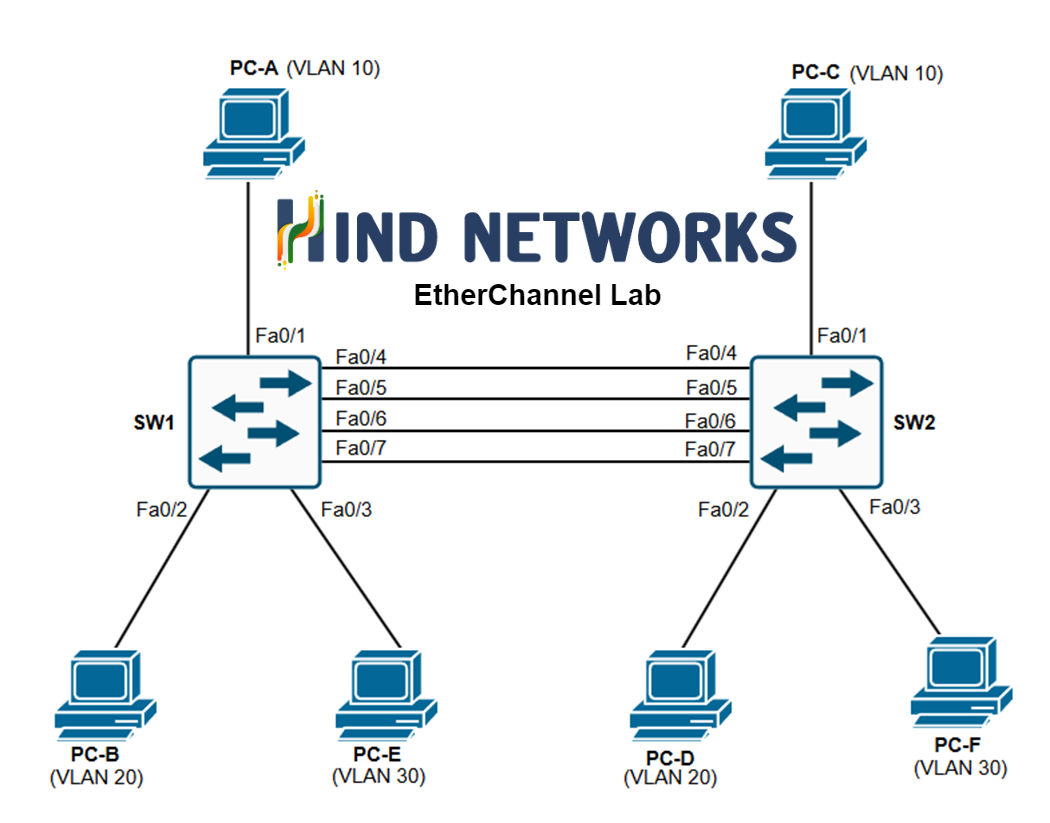
When One Link Wasn’t Enough: The Story of EtherChannel
Imagine this.
It is 9:15 AM on a busy Monday.
Hundreds of employees have just started their day. Applications are running, video meetings are beginning, files are being transferred, and the company network is carrying thousands of packets every second.
In the network room, everything looks normal.
Two switches are connected with four physical Ethernet cables.
The network engineer looks at the switches and thinks:
“We have four links between these switches. Why does the network still behave as if we only have one?”
That simple question leads us to one of the most useful technologies in switched networking:
EtherChannel.
The Problem: More Cables Don’t Always Mean More Bandwidth
Suppose two switches are connected using four 1-Gbps Ethernet links.
At first glance, it seems obvious:
1 Gbps + 1 Gbps + 1 Gbps + 1 Gbps = 4 Gbps
But Ethernet switching has another problem to consider: Layer 2 loops.
If multiple physical paths exist between switches, a broadcast frame could potentially travel around the network indefinitely.
This is why Spanning Tree Protocol (STP) exists.
STP prevents Layer 2 loops by placing redundant paths into a blocking state.
So our four links might look something like this:
Link 1 → Forwarding
Link 2 → Blocking
Link 3 → Blocking
Link 4 → Blocking
The network is safe from loops, but most of the available physical links are not actively forwarding normal traffic.
The engineer now has a problem.
How can we use multiple physical links while making the network see them as a single logical connection?
The answer is EtherChannel.
What Is EtherChannel?
EtherChannel is a technology that combines multiple physical Ethernet interfaces into one logical interface.
The physical links are grouped together and represented as a single logical interface called a:
Port-Channel
For example:
Without EtherChannel
Switch A
   |
   +------ 1 Gbps ------ Switch B
   |
   +------ 1 Gbps ------ Switch B
   |
   +------ 1 Gbps ------ Switch B
   |
   +------ 1 Gbps ------ Switch B
These are four individual physical links.
With EtherChannel:
              Port-Channel
Switch A ===================== Switch B
          |   |   |   |
         1G  1G  1G  1G
The four physical interfaces operate as members of one logical EtherChannel.
The switches can therefore use the links as an aggregated connection while maintaining redundancy.
Why Is EtherChannel Important?
EtherChannel solves more than one problem.
It provides three major benefits:
1. Increased Aggregate Bandwidth
Multiple physical links can be combined to provide greater total capacity.
For example:
4 × 1-Gbps links = 4 Gbps aggregate capacity
The exact usable throughput depends on traffic patterns and the platform’s load-balancing algorithm.
2. Redundancy
Imagine four links are working together and one cable suddenly fails.
Without EtherChannel, that failure could require a topology change.
With EtherChannel, the remaining member links can continue carrying traffic.
Before Failure

Switch A ======= Switch B
        4 Links


After One Link Fails

Switch A ======= Switch B
        3 Links
The EtherChannel can remain operational as long as enough valid member links remain and the configuration supports it.
3. Simplified Logical Topology
Instead of managing several independent links at the logical level, the network treats the group as one logical interface.
This makes network design and management much cleaner.
A Real-World Example
Let’s return to our network engineer.
The company has two distribution switches connected using four 1-Gbps links.
During normal business hours, traffic between the switches is heavy.
The engineer decides to configure the four links as an EtherChannel.
After the configuration, the switches see:
Physical Interfaces
- GigabitEthernet 1/0/1
- GigabitEthernet 1/0/2
- GigabitEthernet 1/0/3
- GigabitEthernet 1/0/4
↓
Logical Interface
- Port-Channel 1
Now the four physical links belong to the same logical bundle.
If one physical cable fails, the other links can continue carrying traffic.
The network has gained both capacity and resiliency.
Does One File Download Become 4 Times Faster?
This is one of the most common misunderstandings about EtherChannel.
The answer is:
Not necessarily.
EtherChannel uses a load-balancing algorithm to decide which physical member link should carry a particular traffic flow.
Depending on the switch and configuration, the hashing calculation may use information such as:
- Source MAC address
- Destination MAC address
- Source and destination IP addresses
- Source and destination TCP/UDP ports
This means multiple traffic flows can be distributed across different physical links.
For example:
User A ──────── Link 1
User B ──────── Link 2
User C ──────── Link 3
User D ──────── Link 4
So EtherChannel is primarily about aggregate bandwidth across multiple traffic flows, rather than automatically making a single flow four times faster.
This distinction is important when designing high-performance networks.
EtherChannel Protocols
There are several ways to create an EtherChannel.
The two important negotiation protocols you will commonly encounter are:
LACP
LACP — Link Aggregation Control Protocol
LACP is an industry-standard protocol defined by IEEE.
It allows devices to negotiate and form link aggregation dynamically.
Common LACP modes include:
- Active
- Passive
An active interface actively attempts to form the EtherChannel.
A passive interface waits for the other side to initiate negotiation.
For example:
Switch A                 Switch B
LACP Active  <--------->  LACP Passive

             ↓

        EtherChannel
LACP is widely preferred in modern multi-vendor networks because it is based on an open standard.
PAgP
PAgP — Port Aggregation Protocol
PAgP is a Cisco proprietary EtherChannel negotiation protocol.
Its common modes are:
- Desirable
- Auto
Desirable actively attempts to negotiate the EtherChannel.
Auto waits for the other side to initiate negotiation.
Switch A                 Switch B
PAgP Desirable <-------> PAgP Auto

             ↓

        EtherChannel
PAgP is mainly relevant when working in Cisco-specific environments and is also important knowledge for networking certifications.
Static EtherChannel
EtherChannel can also be configured without a negotiation protocol.
This is commonly called static EtherChannel and uses the on mode.
Switch A                 Switch B
     ON  ===============  ON

             ↓

        EtherChannel
Because there is no negotiation protocol, the administrator must make sure both sides are configured correctly.
A mismatch can prevent the EtherChannel from forming properly.
EtherChannel and STP
Here is one of the most important concepts to understand.
STP sees the EtherChannel as one logical link.
Suppose you have four physical links:
Switch A
 | | | |
 | | | |
Switch B
Without EtherChannel, STP sees multiple paths.
With EtherChannel:
Switch A
    |
    |   Port-Channel 1
    |
Switch B
The physical links are members of the same logical bundle.
This allows the network to maintain redundancy without treating each physical link as a separate Layer 2 path.
What Happens When a Link Fails?
This is where EtherChannel becomes particularly valuable.
Imagine four links are operating:
Link 1 ✓
Link 2 ✓
Link 3 ✓
Link 4 ✓
Suddenly, Link 3 fails.
Link 1 ✓
Link 2 ✓
Link 3 ✗
Link 4 ✓
The EtherChannel can continue operating over the remaining links.
Users may not even notice the individual cable failure.
The network administrator can then replace the failed cable without necessarily taking the entire logical connection offline.
Common EtherChannel Mistakes
EtherChannel is powerful, but configuration mismatches are common.
Some important things to check include:
Speed and Duplex
Member interfaces should have compatible physical settings.
Access or Trunk Mode
The member interfaces should have compatible switchport configurations.
VLAN Configuration
For trunk EtherChannels, VLAN and trunk parameters should be consistent.
Negotiation Mode
Make sure the selected LACP/PAgP/static modes are compatible on both sides.
Number of Interfaces
Both sides should have a compatible EtherChannel design.
Configuration Consistency
Member interfaces should generally have matching relevant Layer 2 and Layer 3 parameters.
EtherChannel in One Picture
The entire concept can be remembered like this:
        SWITCH A
        ┌─────────┐
        │         │
        │         │
        └─────────┘
          ║ ║ ║ ║
          ║ ║ ║ ║
          ║ ║ ║ ║
       ┌─────────────┐
       │ Port-Channel│
       └─────────────┘
          ║ ║ ║ ║
          ║ ║ ║ ║
          ║ ║ ║ ║
        ┌─────────┐
        │         │
        │         │
        └─────────┘
        SWITCH B

     Multiple Physical Links
               ↓
        One Logical Link
               ↓
        EtherChannel
The Final Lesson
The network engineer looks at the four cables again.
A few minutes earlier, they were simply four separate physical connections.
Now they are part of one logical connection.
The network has:
More aggregate bandwidth.
Redundancy against individual link failures.
A cleaner logical topology.
And most importantly, the network can use multiple physical links without treating them as separate Layer 2 paths.
That is the power of EtherChannel.
Remember:
EtherChannel = Multiple Physical Links + One Logical Link
Whether you are studying for CCNA, preparing for a networking interview, or designing a real enterprise network, understanding EtherChannel is an essential part of understanding modern switched networks.
Quick Revision
| Feature | EtherChannel |
|---|---|
| Purpose | Combine multiple physical links |
| Logical Interface | Port-Channel |
| Main Benefit | Aggregate bandwidth + redundancy |
| Standard Protocol | LACP |
| Cisco Protocol | PAgP |
| Static Mode | On |
| STP View | One logical link |
| Load Balancing | Hash-based across member links |
| Common Use | Switch-to-switch / switch-to-server connectivity |
One-Line Definition
EtherChannel is a technology that bundles multiple physical Ethernet links into a single logical connection to provide increased aggregate bandwidth, redundancy, and simplified network topology.