
Wireless Networking Explained Simply
Have you ever connected your laptop 💻 or smartphone 📱 to Wi-Fi and wondered how data travels without cables?
This magic is called Wireless Networking 🌐 — an essential concept in modern networks and CCNA basics.
🔍 What is Wireless Networking?
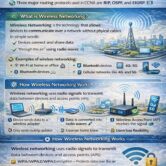
Wireless Networking is the technology that allows devices to communicate over a network without physical cables.
In simple words:
👉 Devices connect and share data “through the air” using radio waves 📶.
Examples of wireless networking:
Wi-Fi at home or office 🏠🏢
Bluetooth devices 🔵
Cellular networks like 4G and 5G 📱
❓ Why Do We Need Wireless Networking?
Wireless networking provides several advantages ✅:
Mobility – Move devices freely while staying connected 🚶♂️
Convenience – No messy cables to manage 🪢
Easy scaling – Add devices without extra wiring ➕
Cost-effective – Reduces infrastructure costs 💰
Without wireless networking ❌:
Devices are restricted to wired connections
Expanding networks becomes harder
Users lose flexibility
⚙️ How Wireless Networking Works
Wireless networking uses radio signals to transmit data between devices and access points (APs):
1️⃣ Device sends data to a wireless adapter 📡
2️⃣ Data is converted into radio waves 🌊
3️⃣ Wireless Access Point (AP) receives the signal and forwards it to the network 🔀
4️⃣ Data reaches its destination device or router 🎯
Modern Wi-Fi standards (like 802.11ac and 802.11ax) allow high-speed and secure connections ⚡.
🛡️ Wireless Security
Wireless networks are more vulnerable than wired networks ⚠️. Security measures include:
🔑 WPA/WPA2/WPA3 encryption – Protects data over the air
🛑 MAC filtering – Only allows authorized devices
📶 SSID hiding – Makes the network less visible
🔍 Firewall & monitoring – Protects from attacks
🌍 Real-Life Example
Think of wireless networking like walkie-talkies 📻:
Two devices communicate over radio waves
No wires are needed
Proper channels and security keep communication safe
Wi-Fi just works on the same principle but with higher speed and advanced protocols.
🎓 Wireless Networking in CCNA Exam
For CCNA 200-301, wireless networking is part of networking fundamentals:
Wireless standards (802.11a/b/g/n/ac/ax)
Wireless security protocols
Access points and client communication
Troubleshooting Wi-Fi issues 🛠️
Understanding how wireless networks function and their security is key for exams.
✅ Final Takeaway
Wireless networking allows devices to connect, communicate, and share data without cables 🌐.
It provides mobility, flexibility, and convenience but requires proper security to stay safe 🔐.
For CCNA students, mastering wireless concepts is essential for modern networking knowledge 🚀.