
Networking Essentials
Every application on a computer or network device uses a port number to communicate correctly 🌐.
Ports act like doors 🚪 — they allow traffic to reach the right service on a device.
There are two main types of ports used in networking:
TCP (Transmission Control Protocol) ports ✅
UDP (User Datagram Protocol) ports ⚡
Understanding the common port numbers is essential for CCNA students and network troubleshooting.
🔹 What Are TCP and UDP?
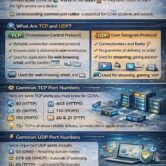
TCP (Transmission Control Protocol)
Reliable, connection-oriented protocol ✅
Ensures data is delivered in order and without loss
Used for applications like web browsing, email, and file transfers
UDP (User Datagram Protocol)
Connectionless and faster ⚡
No guarantee of delivery or order
Used for streaming, gaming, and VoIP
🔹 Common TCP Port Numbers
Here are some TCP ports you must know for CCNA:
🌐 80 (HTTP) – Standard web traffic
🔒 443 (HTTPS) – Secure web traffic
📧 25 (SMTP) – Sending emails
📥 110 (POP3) – Receiving emails
📂 20 & 21 (FTP) – File Transfer Protocol
🖥️ 3389 (RDP) – Remote Desktop
💡 Tip: TCP is all about reliable delivery, so most critical applications use TCP.
🔹 Common UDP Port Numbers
Some important UDP ports include:
🎧 53 (DNS) – Resolving domain names
📺 67 & 68 (DHCP) – Automatic IP addressing
🎮 69 (TFTP) – Lightweight file transfer
📡 123 (NTP) – Time synchronization
🎙️ 500 & 4500 (IPSec VPN) – Secure VPN communication
💡 Tip: UDP is faster but less reliable, ideal for streaming and real-time applications.
🌍 Real-Life Example
Think of ports like hotel room numbers 🏨:
The hotel building is your device
Doors (ports) allow guests (data packets) to reach the correct room (application)
TCP rooms ensure guests arrive safely ✅
UDP rooms let guests in quickly ⚡ but don’t check if they arrive perfectly
🎓 Port Numbers in CCNA Exam
For CCNA 200-301, knowing common TCP & UDP ports is crucial:
Questions often appear in network troubleshooting scenarios 🛠️
Ports are linked to services and protocols
Understanding TCP vs UDP behavior is key for exam questions
✅ Final Takeaway
Ports are essential for directing traffic to the right services on a network device 🌐.
TCP → Reliable, connection-oriented ✅
UDP → Fast, connectionless ⚡
Knowing common port numbers helps you troubleshoot, secure, and manage networks efficiently 🚀.